The lutheran church -Blythe Campus

After sporadic efforts were made to start the Lutheran presence in the Palo Verde Valley through the
1930’s and 1940’s, it was not until 1949 that work and worship services were begun by a Lutheran pastor
from Yuma, Arizona, Rev. E. Boxdorfer. The first service was February 20, 1949. The congregation was
formally organized in 1950. In early 1950 Rev. Otto from Indio served until the first call went out to
Pastor H.W. “Mike” Mitschke who was the first resident pastor.
Zion was incorporated in 1952 under Pastor Mitschke, and property was also purchased that year. The
groundbreaking for the church was held in September 1952. The church was literally built by church
members and completed in 1954. The parsonage, primarily designed by Pastor Mitschke’s wife Erma,
was finished in 1955. The church flourished under his leadership. Pastor Mitschke also served Grace
Lutheran in Needles and commuted between the two churches by automobile and private airplane.
Pastor Harold Daum, a new graduate from the Seminary, came in 1956. While here, he established a
preaching station in Parker, Arizona. Vacancy pastors served between 1963 and 1964, and during that
time 3 acres of land were purchased to the north of the church from a member, Mr. Nick Caproni.
From 1964 to 1968 Pastor Richard Peterson served Zion. During his pastorate the fellowship hall and
the classroom on the east side of the church was built and dedicated in 1967. Pastor John Meether then
came and served from 1968 to 1973.
In 1973, Pastor Gerald “Gerry” Hoemann was called. In 1975 Messiah Lutheran in Parker became
self-supporting, and Pastor Hoemann no longer served both churches. In 1979 Rev. Grant Kilps was
called to work at Zion with Pastor Hoemann and to open a mission church in Quartzsite, Arizona, and to
begin a Lutheran school at Zion. The Quartzsite mission opened in 1980, and the Zion Lutheran School
opened in the fall of 1981. Pastor Hoemann’s wife Paula was one of two teachers who began the school.
Following Rev. Kilps, Mr. Lonn Maly was called to be the principal, and he came to Zion with his wife
Julie, a called Lutheran teacher. They served fourteen years. The school increased to an enrollment of
120, with 6 full-time teachers. The educational wing was added on the west side of the property to
accommodate the increase of students. Pastor Hoemann also formed a Counseling Center that provided
low-income Christian counseling to the community.
In 1987 a development committee consisting of Lanney Allen, Catherine Brisco, Charley Graham, and
Ernie Weeks worked with the Holt Group to expand the church to a seating capacity of 320 and to add
additional classrooms. The church was remodeled and modernized. The parsonage was converted into an
office complex. The dedication of the new facilities took place in 1988. Pastor Hoemann retired in 2005.
In 2005 Pastor Mark Hoffmann came with his wife Lori to serve Zion. During his time, the church went
solar and adopted the church Mission Statement, Church Motto, and Logo. Zion also celebrated its 60 th
anniversary. Other activities were the yearly talent show, BBQ fundraisers, and Progressive Dinners.
Pastor Mark Yaeger served Zion from 2015 to 2017. Pastor Jonathan Manthei served from 2019 until
2026. During his time, he introduced Trunk or Treat as an alternative to Halloween and spearheaded the
Advent and Lenten soup suppers.
To God be all the glory for all that has transpired over the years here at Zion. May these 77 years be just a
small beginning to a continuing great future. We look forward to what God has planned for Zion’s future
mission….
SOLI DEO GLORIA
Welcome to Zion Lutheran Church - Blythe Church
History of pastoral care

church records

groundbreakers
charter members
77 years of history
77 years of history
The lutheran church - missouri synod
History
The Lutheran Church—Missouri Synod
Founded in 1847
The roots of The Lutheran Church—Missouri Synod trace back to 1847, when Saxon and other German immigrants established a new church body in America, seeking the freedom to practice and follow confessional Lutheranism.
Initial members, which included 12 pastors representing 14 congregations from Illinois, Indiana, Missouri, Michigan, New York and Ohio, signed the church body’s constitution on April 26, 1847, at First Saint Paul Lutheran Church in Chicago, Ill.
Originally named The German Evangelical Lutheran Synod of Missouri, Ohio and Other States, the name was shortened to The Lutheran Church—Missouri Synod in 1947 on the occasion of our 100th anniversary.
Over the years, hundreds of books chronicling the Synod’s rich history have been written. One of the most comprehensive is Zion on the Mississippi.
The First President
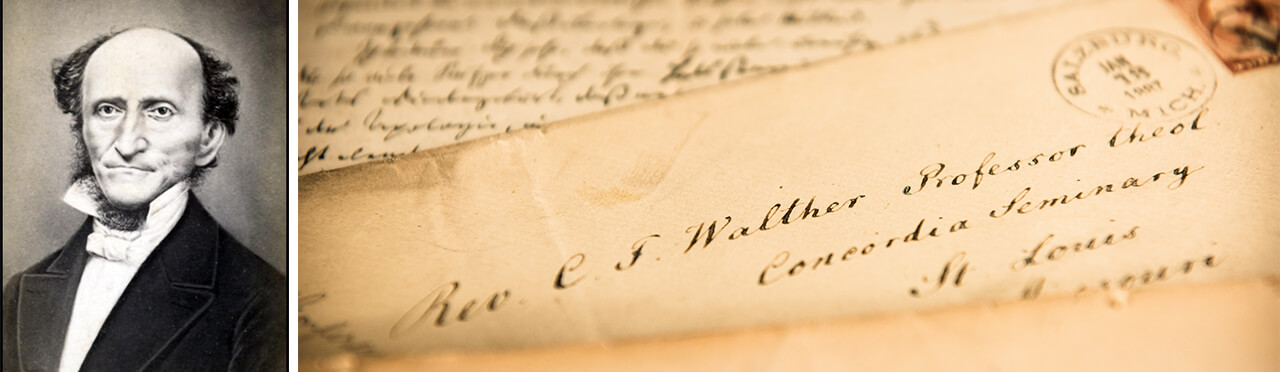
The Rev. Dr. C.F.W. Walther (Oct. 25, 1811 – May 7, 1887) served as the first president of the church body. As a young pastor, Walther joined the Saxon Germans who immigrated to the United States in 1839, and, at only 27 years old, he was the leader of the group that settled in Perry County, Mo.
Dr. Walther played a key role in the founding of the LCMS in 1847, and he served as the church body’s first president, holding office from 1847 to 1850 and again from 1864 to 1878.
Walther presided over the young Synod, leading its growth through the years of the great migration of German immigrants. He served as president of Concordia Seminary from 1850 to 1887, and he was editor of Der Lutheraner, a leading magazine of the day that reached Confessional Lutherans across the country.
Today, Walther is revered as the leading Lutheran theologian of his time, and he’s fondly known as the “Father of the Missouri Synod.”
